
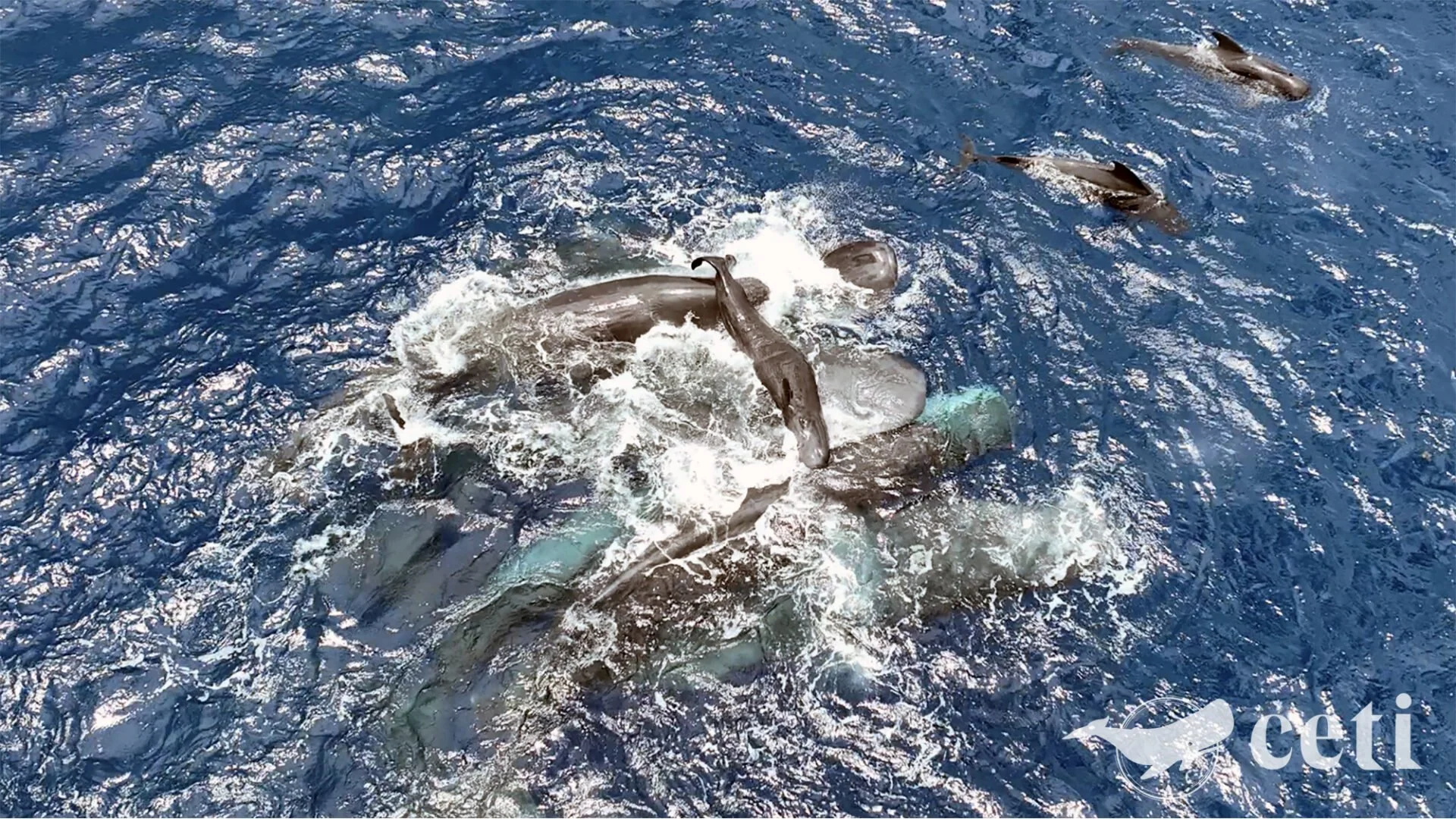
Female sperm whales holding newborn above water shortly after birth. Photo credit: Project CETI
Today we're highlighting the Untraditional Philanthropy Expert whose team spent 2026 doing what most of the world considers science fiction: learning to listen to whales.
Fiona Korwin-Pawlowski is Chief Strategy Officer of Project CETI (Cetacean Translation Initiative), a nonprofit that works in collaboration with the National Geographic Society. CETI brings together marine biologists, linguists, roboticists, cryptographers and AI researchers with one audacious goal: decoding the communication of sperm whales. We believe the most important philanthropy funds the questions nobody else will touch. CETI is proof.
In March, CETI's researchers published what may be the most remarkable animal behavior paper of the year in the journal Science. Using drone footage and machine learning, the team documented a sperm whale birth off the coast of Dominica in unprecedented detail. Eleven whales from two normally separate family groups worked together to support the mother and lift her newborn calf to the surface. It is the first quantitative evidence of cooperative birth assistance in any animal other than primates. For context, only four sperm whale births had been reported in the previous 60 years. National Geographic covered the findings and the footage behind them.
In April, CETI made headlines again. On NPR's All Things Considered, linguistics lead Gašper Beguš explained the team's discovery that sperm whale clicks, when sped up and stripped of their silences, contain sounds that work like human vowels. National Geographic called it a step closer to understanding the sperm whale "alphabet." So far the team has identified two whale vowels, roughly equivalent to our a and i. That is two more than most of us expected.
In July, the work turned urgent. A new CETI study, reported by National Geographic, found that shipping noise changes the messages sperm whales send and may change how those messages are received. This is where the science becomes a conservation agenda. CETI's founders point to the 1970s, when recordings of humpback whale songs helped launch the "Save the Whales" movement. Their bet is that understanding what whales say will move the public and policymakers to protect them.
We don't believe in safe bets. We believe in long-horizon, high-risk, high-reward work led by people with the patience to see it through, and Fiona and the CETI team embody exactly that. Learn more about Fiona on her Untraditional Philanresearch at projectceti.org.